
Resume Mistakes That Quietly Cost You Interviews
Most resume problems are not dramatic. They are small clarity issues that make recruiters miss your fit, underestimate your experience, or move on too quickly.
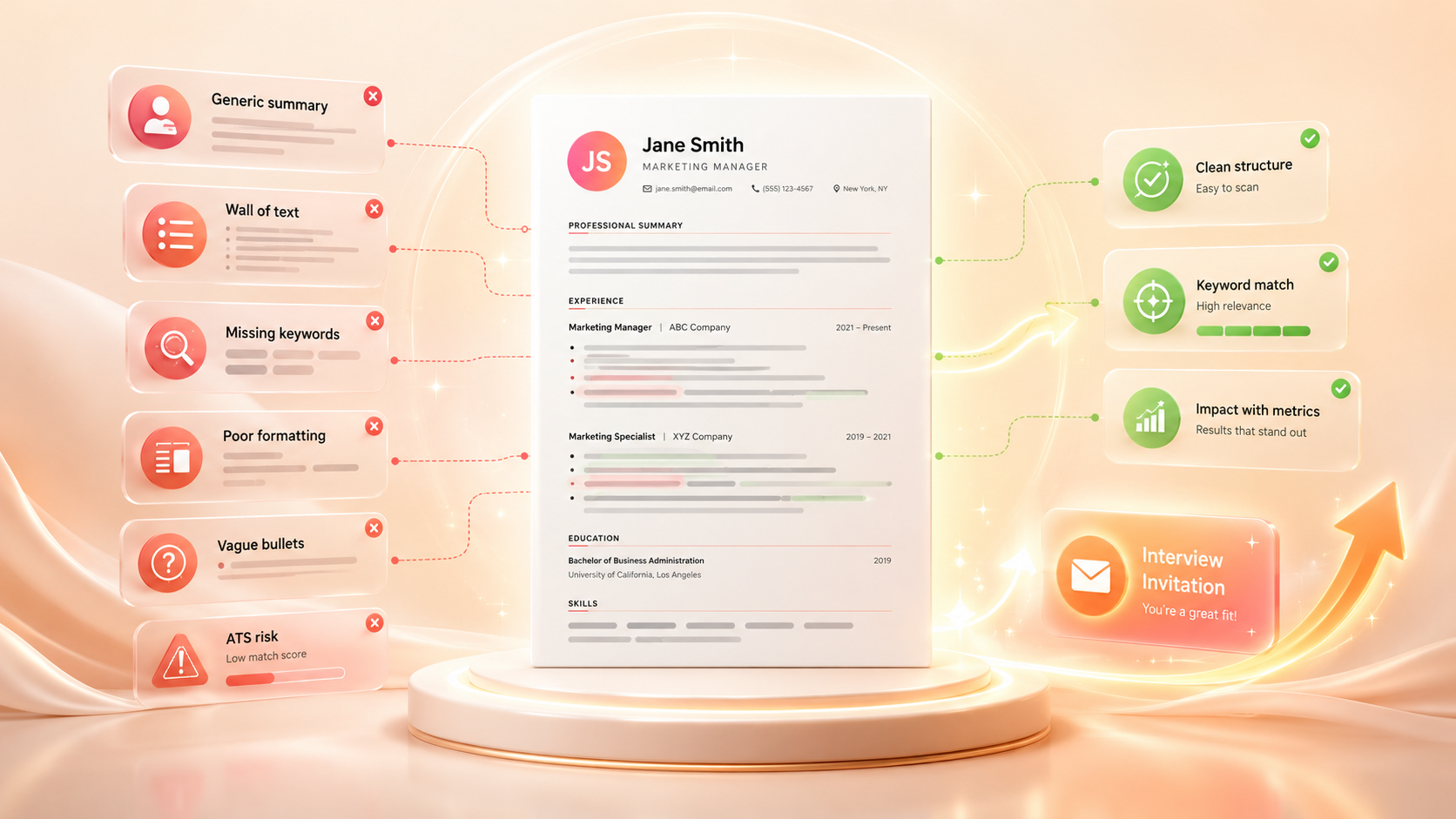
If your resume is not getting interviews, it does not always mean you are unqualified.
It may mean your resume is making your qualifications too hard to see.
That is what makes resume mistakes frustrating. They are often quiet. The resume may look fine. It may have no typos. It may list your jobs accurately. It may even be visually polished.
But if it does not quickly show the right experience for the right role, it can still fail.
Recruiters are not reading your resume slowly with a highlighter and a cup of coffee. They are scanning. They are comparing. They are trying to decide whether you belong in the next pile.
Small issues can change that decision.
Why resume mistakes are hard to notice
You know your own career too well.
When you read your resume, you automatically fill in the blanks. You remember the project.
You know what “managed reporting” involved. You know that “worked with internal teams” meant coordinating between sales, product, and operations.
A recruiter does not know that.
They only know what the resume says.
That is why a resume can feel accurate to you but vague to everyone else.
A good resume does not rely on the reader to understand your context. It gives them enough information to see the value quickly.
“Your resume is not a memory aid for you. It is a translation tool for someone who does not know your work yet.”
Mistake 1: Being too generic
Generic resumes are one of the most common reasons qualified people get ignored.
A generic resume says:
Say this
Strong communicator” → “Presented weekly project updates to clients and internal stakeholders
That sounds fine, but it does not tell the recruiter what you actually do.
Specific is stronger:
The second version gives the reader a clearer picture.
Generic bullets have the same problem.
Weak:
Stronger:
The fix is to replace broad claims with concrete work.
“Team player” → “Coordinated launch tasks across design, marketing, and sales teams”
Mistake 2: Leading with a weak summary
The top of your resume is valuable space.
Experienced professional with strong communication and leadership skills.
Operations manager with experience improving workflows, coordinating cross- functional teams, and reducing process bottlenecks in fast-moving service environments.
Worked on marketing campaigns.
Coordinated weekly campaign launches across email, paid media, and sales enablement to support lead generation goals.
If your summary is vague, outdated, or filled with filler words, you lose the chance to frame your experience.
Weak summary:
This says almost nothing.
Better:
A strong summary should tell the reader:
- What you do
- Your level of experience
- Your most relevant strengths
- Why your background fits the target role
It should not be a personal mission statement. It should be positioning.
Mistake 3: Listing duties instead of impact
A resume full of duties can make you sound passive.
Duties describe what the job required. Impact describes what you contributed.
Duty:
Impact:
Duty:
Impact:
Motivated professional seeking a challenging opportunity where I can grow and contribute to a team.
Project manager with 5+ years of experience coordinating cross-functional timelines, managing stakeholder communication, and improving delivery processes for client- facing teams.
Responsible for onboarding new clients.
Managed onboarding for new clients by coordinating kickoff calls, documentation, and internal handoffs, improving clarity during the first 30 days.
Created reports.
You do not need a metric in every bullet, but you need enough context for the work to matter.
If your resume reads like a job description, rewrite it to sound like a record of contribution.
Recruiters already know the job duties. Show what you did with them.
Mistake 4: Hiding relevant keywords
Keywords help recruiters and applicant tracking systems understand fit.
But many candidates leave out obvious role-specific language.
For example, a job description may mention:
- Project management
- KPI reporting
- Salesforce
- Stakeholder communication
- Budget tracking
If you have that experience, but your resume uses vague wording instead, you may miss an easy match.
This does not mean stuffing keywords. It means using accurate terms.
Do not make the recruiter infer what you can state clearly.
- If you used Salesforce, say Salesforce
- If you managed budgets, say budget tracking
- If you created KPI reports, say KPI reporting
See how your resume scores
Upload your resume and ResumeShine highlights what to fix — keywords, impact, and formatting — in minutes.
Mistake 5: Overdesigning the resume
Built weekly performance reports that helped leadership track campaign results, budget shifts, and lead quality.
A beautiful resume can still be ineffective.
Overdesigned resumes often create problems with readability. They may use multiple columns, icons, skill bars, text boxes, photos, graphics, or unusual layouts that look interesting but make the actual content harder to scan.
For most jobs, clarity beats decoration.
That does not mean your resume should be ugly. It should look clean, modern, and intentional. But the design should never compete with the information.
A good resume design helps the reader move through the page. It does not ask the reader to admire the layout before understanding the candidate.
Mistake 6: Making the reader guess your level
Sometimes the resume does not clearly show whether the person is junior, mid-level, senior, or leadership-ready.
This happens when bullets are too flat.
For example:
That could mean almost anything.
A clearer version:
Helped with project updates.
Now the reader understands scope and communication level.
If you are applying for senior roles, your resume should show senior signals:
- Ownership
- Decision-making
- Strategy
- Complexity
- Leadership
- Cross-functional influence
- Business impact
- Mentoring or management
- Executive communication
If those things are real, make them visible.
Mistake 7: Using the same resume everywhere
The same resume will not work equally well for every job.
A resume for a project manager role should not be identical to a resume for an operations manager role, even if the candidate could do both.
The experience may overlap, but the emphasis should change.
For a project manager role, emphasize timelines, stakeholders, deliverables, and risks.
For an operations role, emphasize process, efficiency, systems, and workflow improvement.
For a customer success role, emphasize retention, onboarding, client relationships, and account health.
Using the same resume everywhere is easier, but it often makes every application weaker.
blockers, and next steps across three active client projects.
Each branch has different highlighted keywords.
Mistake 8: Not proofreading the final file
Tiny mistakes can hurt trust.
A typo may not destroy your chances, but it can create doubt. Inconsistent dates, mismatched fonts, broken links, spacing issues, and incorrect company names can make the resume feel rushed.
Before submitting, check:
- Spelling
- Grammar
- Date consistency
- File name
- Contact information
- LinkedIn link
- Portfolio link
- Company names
- Job titles
- Formatting after export
- Correct version for the role
One common mistake is uploading the wrong version. If your file name says “Marketing Manager Resume” but you are applying for a project manager role, that looks careless.
Use a clean file naming system:
FirstName-LastName-TargetRole-Resume.pdf
Key takeaways
Remember these
- Most resume mistakes are clarity problems.
- Generic resumes make recruiters do too much work.
- Impact matters more than task lists.
- Keywords should appear naturally where they match real experience.
- Good formatting supports the content instead of distracting from it.
Final takeaway
A resume does not need to say everything.
It needs to make the right things impossible to miss.
Frequently asked questions
The biggest mistake is being too generic. A generic resume makes it hard for recruiters to see why you fit a specific role.
Yes, especially if the role requires attention to detail. One typo may not ruin everything, but several mistakes can damage trust.
Not necessarily. A resume can look modern and still be effective. The problem is design that makes the resume harder to read or parse.
Use a strong base resume, but tailor it for serious applications.
It may need stronger positioning, clearer impact, better keyword alignment, or a more focused target role.