
How to Write Resume Bullets That Show Real Impact
Recruiters do not just want to know what you were responsible for. They want to understand what changed because of your work.
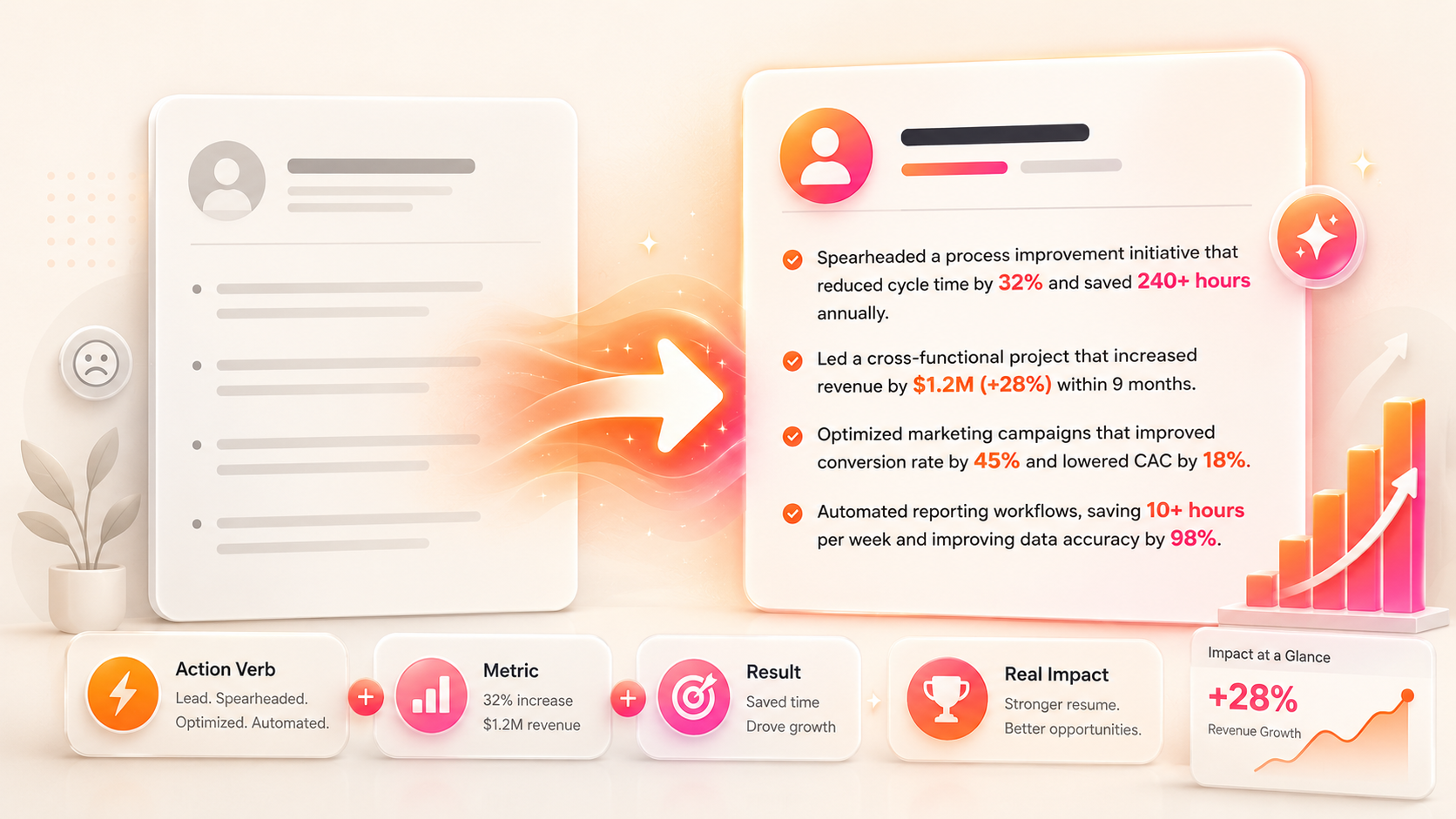
Most resume bullets are technically accurate but strategically weak.
They say what the person did, but not why it mattered.
A bullet like “Responsible for weekly reports” may be true, but it does not tell the reader what kind of reports, who used them, what decisions they supported, or whether anything improved because they existed.
A stronger bullet might say:
Better answer
A resume bullet should not just prove you were there. It should prove your work mattered.
That version gives the work meaning.
Writing stronger resume bullets is not about making everything sound dramatic. It is about giving the reader enough context to understand your contribution.
A good bullet answers three questions:
- What did you actually do?
- How did you do it?
- What changed because of it?
What did you do?
How did you do it?
Why did it matter?
Why most resume bullets feel weak
Weak bullets usually have one of four problems.
They are too vague. They use phrases like “helped with,” “worked on,” or “responsible for” without explaining the actual contribution.
They are too disconnected from the target job. They may be true, but they do not support the role the candidate wants next.
They are too modest. Many candidates understate their work because they do not want to sound like they are bragging.
The result is a resume that looks busy but not impressive.
This matters because recruiters scan quickly. If your bullets do not show relevance and impact fast, your strongest experience may be missed.
- They are too task-focused. They describe duties but not outcomes
Built weekly KPI reports that helped marketing and sales teams track campaign performance, identify budget shifts, and improve lead quality.
Responsibility vs impact
A responsibility is something you were expected to do.
An impact is what happened because you did it well.
Impact:
Impact:
Impact:
The difference is not just wording. It is evidence.
A hiring manager wants to imagine what you might do in their organization. Impact bullets help them do that.
Managed client communication across weekly project updates, reducing confusion around timelines and improving approval speed.
Created training materials.
Created onboarding materials that reduced repeat questions from new hires and standardized training across three departments.
Worked on social media campaigns.
Planned and scheduled weekly social content that increased engagement by 32% and improved consistency across campaign launches.
- Managed client communication
Use three mini examples with arrows. Highlight the “why it mattered” part in warm gradient text.
The impact bullet formula
A useful formula is:
You will not use every piece every time, but the formula helps you think.
Example:
- Action: Led
- Scope: 12 product launches
- Method: shared timelines and stakeholder check-ins
- Result: delivered on schedule
Another example:
- Action: Built
- Scope: weekly campaign reporting
- Method: KPI dashboard
- Result: clearer visibility into performance
Not every bullet needs a hard metric. But every bullet should earn its place.
If a bullet does not show relevance, scope, or impact, ask whether it belongs.
Then show the generated bullet below.
Action + Scope + Method + Result Led cross-functional campaign planning for 12 product launches, using shared timelines and stakeholder check-ins to deliver each launch on schedule.
Built a KPI dashboard for weekly campaign reporting, giving leadership clearer visibility into budget efficiency, lead quality, and conversion trends.
Add a small “Copy formula” button.
Start with stronger verbs
The first word of a bullet matters because it frames your level of ownership.
Weak verbs make your work sound passive.
Common weak openings:
- Helped
- Assisted
- Worked on
- Responsible for
- Involved in
- Participated in
Sometimes those words are accurate, especially if you were truly supporting someone else. But they are often less precise than they could be.
Stronger verbs include:
- Led
- Managed
- Built
- Created
- Improved
- Increased
- Reduced
- Streamlined
- Coordinated
- Analyzed
- Launched
- Developed
- Presented
- Implemented
- Optimized
- Delivered
The goal is not to inflate your role. The goal is to choose the verb that accurately describes your contribution.
If you coordinated the work, say coordinated. If you built the dashboard, say built. If you owned the process, say owned. If you supported the process, say supported and explain how.
Add metrics when possible
Numbers make impact easier to understand.
A metric can show:
- Revenue gained
- Costs reduced
- Time saved
- Conversion improved
- Volume handled
- Projects completed
- Customers supported
- Team size
- Budget managed
- Accuracy improved
- Response time reduced
Before:
After:
Improved reporting process.
Before:
After:
Numbers give the reader scale.
But only use numbers you can defend. Do not invent percentages because they sound good. If you do not know the exact number, use scope instead.
See how your resume scores
Upload your resume and ResumeShine highlights what to fix — keywords, impact, and formatting — in minutes.
Use scope when metrics are missing
Not every job gives you clean performance metrics. That is normal.
Scope can still make a bullet stronger.
Scope includes:
- How many people
- How many projects
- How often
- Which teams
- Which tools
- Which customers
- Which regions
- Which budgets
- How complex
- How time-sensitive
Example:
That bullet does not include a performance metric, but it shows scope.
Another example:
Reduced weekly reporting time by 4 hours by automating dashboard updates and standardizing KPI definitions.
Managed support tickets.
Resolved 50+ customer tickets per week while maintaining strong satisfaction scores and documenting recurring product issues.
Coordinated weekly status updates across five departments to keep launch timelines aligned.
Again, no metric, but the reader understands the range of responsibility.
If you cannot show the result, show the scale. If you cannot show the scale, show the complexity. If you cannot show complexity, show the purpose.
This card should feel like a useful writing tool.
Match bullets to the job
A strong bullet is not just impressive. It is relevant.
If the job description emphasizes stakeholder communication, make sure your stakeholder communication examples are clear.
If the job description emphasizes data analysis, do not hide your analysis work in the fourth bullet of an old role.
If the job description emphasizes leadership, use bullets that show ownership, decision- making, and influence.
Resume bullets should be selected and ordered based on the role you want, not just the role you had.
For example, if you are applying for a project manager job, this bullet may matter more:
If you are applying for an analytics role, this bullet may matter more:
Both might be true, but the right emphasis depends on the target job.
Managed scheduling, documentation, and client communication for multiple active projects across design and development teams.
Managed timelines, stakeholder updates, and risk tracking for cross-functional launch projects.
Built reporting dashboards to track performance trends, identify bottlenecks, and summarize insights for leadership.
Same background. Different emphasis.
Before and after examples
Marketing Before:
After:
Project management Before:
After:
Customer support Before:
After:
Responsible for email marketing.
Created segmented email campaigns that increased click-through rate by 18% and improved trial-to-paid conversion.
Managed projects.
Managed timelines, stakeholder communication, and launch checklists for 12 cross- functional projects delivered on schedule.
Answered customer tickets.
Resolved 50+ customer tickets per week while documenting recurring issues and escalating product feedback to internal teams.
Operations Before:
After:
Design Before:
After:
Early-career Before:
After:
Same experience. Stronger impact.
Bullet mistakes to avoid
Avoid writing bullets that are so broad they could apply to anyone.
Avoid making every bullet sound like a miracle. Not every task increased revenue or transformed the company.
Helped improve processes.
Streamlined intake process for customer requests, reducing handoff confusion and improving response consistency across support and operations.
Created graphics for marketing.
Designed campaign graphics, landing page assets, and social media visuals that supported product launches across email, paid, and organic channels.
Assisted with research project.
Collected, organized, and summarized survey data for a semester-long research project presented to faculty reviewers.
Avoid using metrics without context. “Increased engagement by 20%” is stronger when the reader knows what kind of engagement, for what channel, and why it mattered.
Avoid using internal jargon that outsiders will not understand.
Avoid writing bullets that are four lines long. If a bullet becomes a paragraph, tighten it.
Avoid repeating the same verb again and again.
Most importantly, avoid exaggerating. A resume bullet should help you get the interview, but it should not create a story you cannot defend once you are there.
Key takeaways
Remember these
- Strong bullets show action, scope, and result.
- Responsibilities say what you were assigned; impact shows what changed.
- Numbers help, but scope can be just as useful.
- The best bullets are relevant to the job you want next.
- Do not exaggerate results you cannot explain.
Final takeaway
Better bullets create better interviews.
Make your real impact easy to see, easy to believe, and easy to connect to the role.
Frequently asked questions
Most roles should have 3–6 bullets. Recent and relevant roles can have more. Older or less relevant roles can have fewer.
No. Metrics help, but scope, complexity, and outcomes also matter.
No. Resume bullets usually omit first-person language.
Be honest, but specific. Instead of “helped with project,” say what you supported: scheduling, research, reporting, client communication, documentation, testing, or coordination.
ResumeShine should not invent metrics. It can help surface places where metrics might exist and ask you to confirm real numbers.