
How to Tailor Your Resume to a Job Description Without Lying
A tailored resume does not turn you into someone else. It makes your real experience easier for recruiters and applicant tracking systems to connect to the job in front of them.
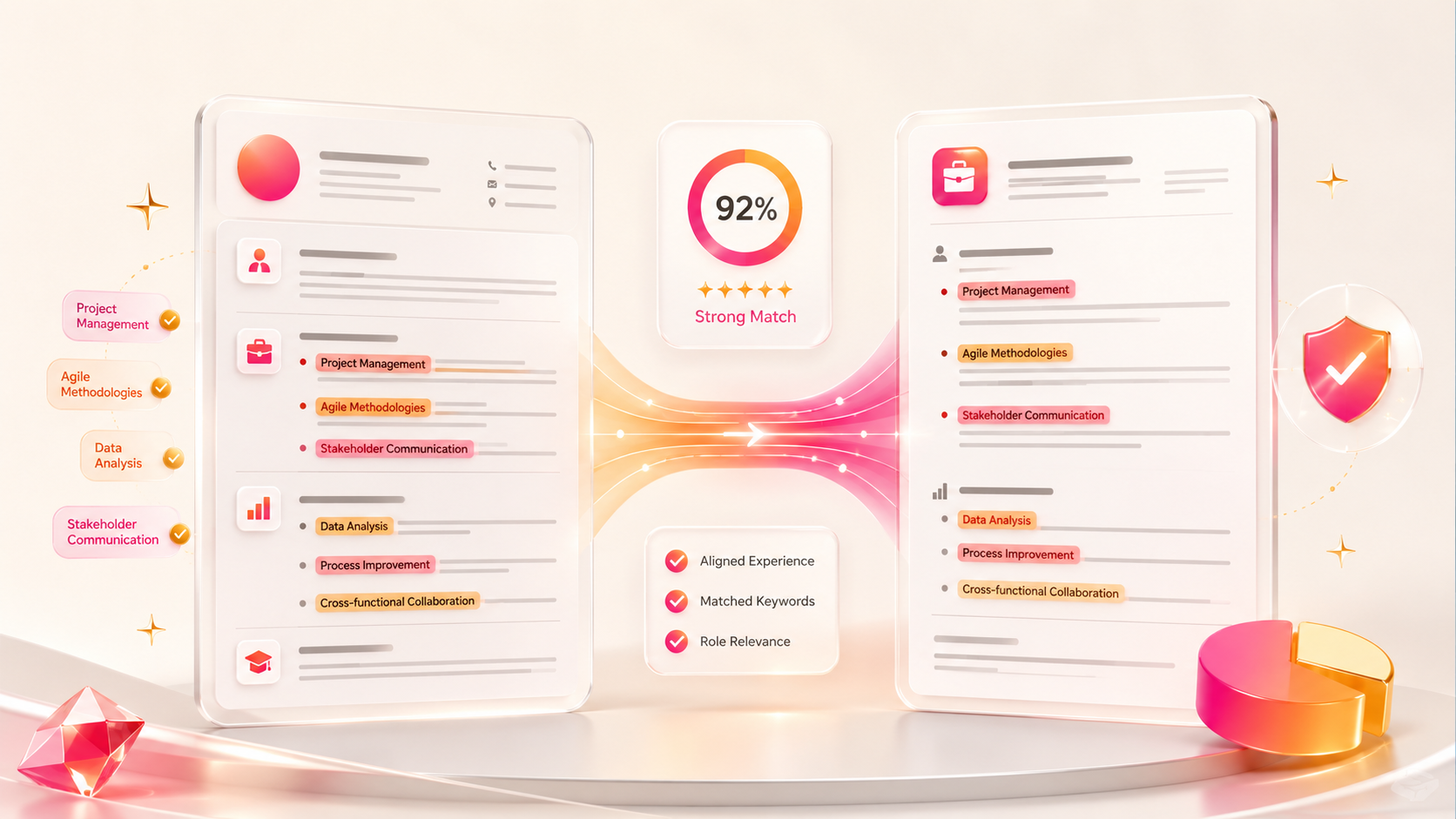
Most people apply to jobs with one general resume.
That makes sense at first. You write one version, polish it, save it as a PDF, and use it everywhere. It feels efficient.
The problem is that recruiters do not review your resume in a vacuum. They review it against a specific job description. They are looking for signs that your experience matches the role they are trying to fill right now.
A generic resume forces them to do the matching work themselves.
A tailored resume makes the match obvious.
That does not mean lying. It does not mean pretending to have experience you do not have. It means reading the job description carefully, identifying where your real background overlaps with the role, and making that overlap easier to see.
The best tailored resume says, “Here is the most relevant version of my real experience for this specific job.”
What tailoring actually means
Tailoring means adjusting the emphasis, language, order, and framing of your resume for a specific role.
It does not mean changing the facts.
If you managed client communication, and the job description says “stakeholder communication,” it may be fair to use that phrase if it accurately describes your work.
If you created weekly reports, and the job description says “KPI reporting,” it may be fair to describe your reports as KPI reporting if they actually tracked key performance indicators.
If you never managed a team, tailoring does not mean calling yourself a people manager.
The honest tailoring zone is the space between underselling and exaggerating. You are not inventing a new career. You are translating your existing experience into the language of the role.
- If you never used Salesforce, tailoring does not mean adding Salesforce
“Tailoring is not about becoming the perfect candidate. It is about making your real fit easier to recognize.”
large.
Why generic resumes underperform
A generic resume usually describes your work in broad terms.
It may say things like:
Say this
Marketing professional with experience in campaigns, communication, and reporting.
Those lines may be true, but they do not tell the employer enough.
A project manager job description might be looking for timeline ownership, stakeholder updates, risk tracking, and cross-functional coordination. A marketing job might be looking for lead generation, campaign performance, KPI reporting, and lifecycle strategy. A customer success role might be looking for retention, onboarding, account health, and client communication.
If your resume stays generic, the recruiter may not connect your experience to those needs.
A tailored resume does that work for them.
Instead of:
Instead of this
KPI, reporting, dashboards, marketing, campaigns, cross-functional, leadership, growth.
A tailored version might say:
Tailored version
Marketing manager with 6+ years of experience leading B2B campaigns, improving qualified lead generation, and building KPI reporting dashboards for cross-functional teams.
That is still the same general activity, but it is much clearer. It tells the reader what kind of reports, why they mattered, and how they connect to the role.
Read the job description like a map
Created reports.
A job description is more than a list of requirements. It is a map of what the company cares about.
Read it slowly and look for repeated signals.
Some job descriptions are messy. They may include too many responsibilities, unrealistic requirements, or vague corporate language. Your job is to identify the parts that actually matter.
Look for words and phrases that appear more than once. Look at the first few bullets under responsibilities. Look at the required qualifications, not just the preferred ones. Pay attention to tools, outcomes, and verbs.
If a job description repeatedly mentions “cross-functional collaboration,” that probably matters. If it mentions “KPI reporting,” “dashboarding,” and “performance analysis,” analytics is likely central to the role. If it mentions “executive communication,” the role probably requires more than just task execution.
The job description is showing you how the employer thinks about the role. Your resume should respond to that.
Identify the top priorities
Not every line in the job description deserves equal attention.
A strong job description may include twenty responsibilities, but usually only three to five define the role.
Before you rewrite anything, identify those top priorities.
For example, a Marketing Manager role might really be about:
A Project Manager role might really be about:
A Customer Success role might really be about:
Once you know the priorities, your resume has a direction. You are no longer trying to make everything sound impressive. You are trying to make the most relevant things unmistakable.
- Campaign strategy
- Lead generation
- KPI reporting
- Cross-functional collaboration
- Budget ownership
- Timeline management
- Stakeholder communication
- Risk management
- Resource coordination
- Delivery accountability
- Account retention
- Onboarding
- Relationship management
- Product adoption
- Renewal support
Tailor toward the role’s real priorities, not every sentence in the posting.
Update your summary
Your resume summary is one of the easiest places to tailor because it sets the frame for everything else.
A generic summary might say:
Generic summary
Marketing professional with experience in campaigns, communication, and reporting.
That summary could apply to thousands of people.
A tailored summary might say:
Tailored summary
Marketing manager with 6+ years of experience leading B2B campaigns, improving qualified lead generation, and building KPI reporting dashboards for cross-functional teams.
That version immediately tells the reader who the candidate is, what kind of work they have done, and why it matches the role.
The summary should not be stuffed with keywords. It should feel like a clear positioning statement.
A good structure is:
For a career changer, the summary may need to create a bridge:
That does not hide the transition. It explains it.
After: Tailored summary Add small caption:
Same background. Sharper positioning.
Marketing professional with experience in campaigns, communication, and reporting.
Strong team player with excellent organizational skills.
Marketing manager with 6+ years of experience leading B2B campaigns, improving qualified lead generation, and building KPI reporting dashboards for cross-functional teams.
Role/title + experience level + most relevant strengths + role-specific proof or focus.
Customer support and operations professional transitioning into project coordination, with 5+ years of experience managing customer issues, improving documentation, and coordinating cross-functional follow-up between support, product, and operations teams.
See how your resume scores
Upload your resume and ResumeShine highlights what to fix — keywords, impact, and formatting — in minutes.
Reorder your skills
A skills section should not be a random drawer of everything you have ever touched.
For a tailored resume, put the most relevant skills first.
If the role emphasizes analytics, lead with analytics. If it emphasizes project management, lead with project management. If the role requires certain tools and you have used them, make them easy to find.
A tailored skills section for a marketing manager might look like:
Example skills section
Campaign strategy · B2B lead generation · KPI reporting · Marketing automation · Budget management · Cross-functional leadership
- Marketing Strategy: B2B Campaigns, Lifecycle Marketing, Lead Generation
- Analytics: KPI Reporting, Dashboarding, Conversion Analysis
- Tools: HubSpot, Salesforce, Google Analytics, Excel
- Collaboration: Stakeholder Communication, Cross-functional Planning, Project
- Management
That is more useful than:
Specific beats broad. Organized beats scattered.
animated-feeling arrows if possible.
Groups:
- Strategy
- Analytics
- Tools
- Collaboration
Keep the styling consistent with ResumeShine’s rounded glass cards.
Rewrite bullets honestly
This is where tailoring matters most.
Marketing, communication, organization, social media, reporting, teamwork, Microsoft Office.
Your work experience bullets should show the reader that you have done work similar to what the role requires.
Start by choosing the bullets that are most relevant to the target job. You do not have to rewrite everything. Often, improving the top three to five bullets does most of the work.
A weak bullet says what you were assigned.
A stronger bullet shows what you did, how you did it, and why it mattered.
Before:
After:
That bullet is stronger because it connects to likely job description language while staying believable.
Before:
After:
Again, this is not fake. It is clearer.
The best tailored bullets are still easy to defend in an interview. If a hiring manager asks, “Tell me about that KPI dashboard,” you should be able to explain what it tracked, who used it, and how you built it.
If you cannot explain the bullet, it probably went too far.
Managed marketing projects and created reports.
Managed cross-functional marketing projects and built KPI reports to track campaign performance, budget efficiency, and lead quality.
Worked with customers to solve issues.
Managed customer issue resolution by coordinating follow-up between support, product, and operations teams, improving handoff clarity for recurring problems.
Built weekly KPI reports to track campaign performance, lead quality, and budget efficiency for marketing and sales stakeholders.
Add copy-style icon and small sparkle accent.
What not to change
Tailoring has a line.
Do not change job titles to make yourself sound more senior unless the title is confusing and you clarify it honestly.
A tailored resume should survive a real interview. That is the test.
If the interviewer asks for details, you should feel confident explaining every line.
- Do not add tools you have never used
- Do not invent metrics
- Do not claim ownership if you only lightly assisted
- Do not remove important context that would make your background misleading
- Do not turn a career gap into a fake consulting business
- Do not copy and paste the job description into your resume
Use a warm shield icon and subtle red/orange warning marks.
Tailoring checklist
Tailoring checklist
- Before you submit, read the resume next to the job description and ask:
- Does my summary point toward this role?
- Are the most relevant skills easy to find?
- Do my top bullets reflect the job’s top priorities?
- Am I using the employer’s language where it truthfully fits?
- Are my strongest examples near the top?
- Have I removed irrelevant clutter?
- Can I explain every claim in an interview?
- Is the resume still easy for a human to read?
- Does the file name look professional?
- A tailored resume should feel sharper, not bloated. If tailoring makes the resume longer, messier, or less believable, tighten it.
Key takeaways
Remember these
- Tailoring is about emphasis, not fabrication.
- The job description tells you what the employer values most.
- Strong tailoring uses the employer’s language when it truthfully matches your experience.
- Your summary, skills, and bullets should all point toward the target role.
- Never add fake tools, fake metrics, fake responsibilities, or fake titles.
Final takeaway
A tailored resume makes the match obvious.
Use the job description as the map, your real experience as the material, and honest wording as the guardrail.
Frequently asked questions
Tailor every serious application. You do not need to spend an hour on every job, but if the role matters, your resume should reflect that specific job description.
No. Keyword stuffing means forcing terms into your resume unnaturally. Tailoring means using relevant language where it truthfully describes your experience.
Manual tailoring can take 20–45 minutes once you know what you are doing. ResumeShine is designed to make the process much faster by analyzing the resume and job description together.
Yes, if you meet the core responsibilities. Tailoring can help show your closest fit, but it should not pretend you meet requirements you do not.
Focus on transferable skills, adjacent responsibilities, projects, coursework, volunteer work, or proof that shows you can do similar work.