
How to Write Resume Bullets That Show Impact
Learn how to write stronger resume bullets using action verbs, metrics, scope, outcomes, and examples that make your experience stand out.
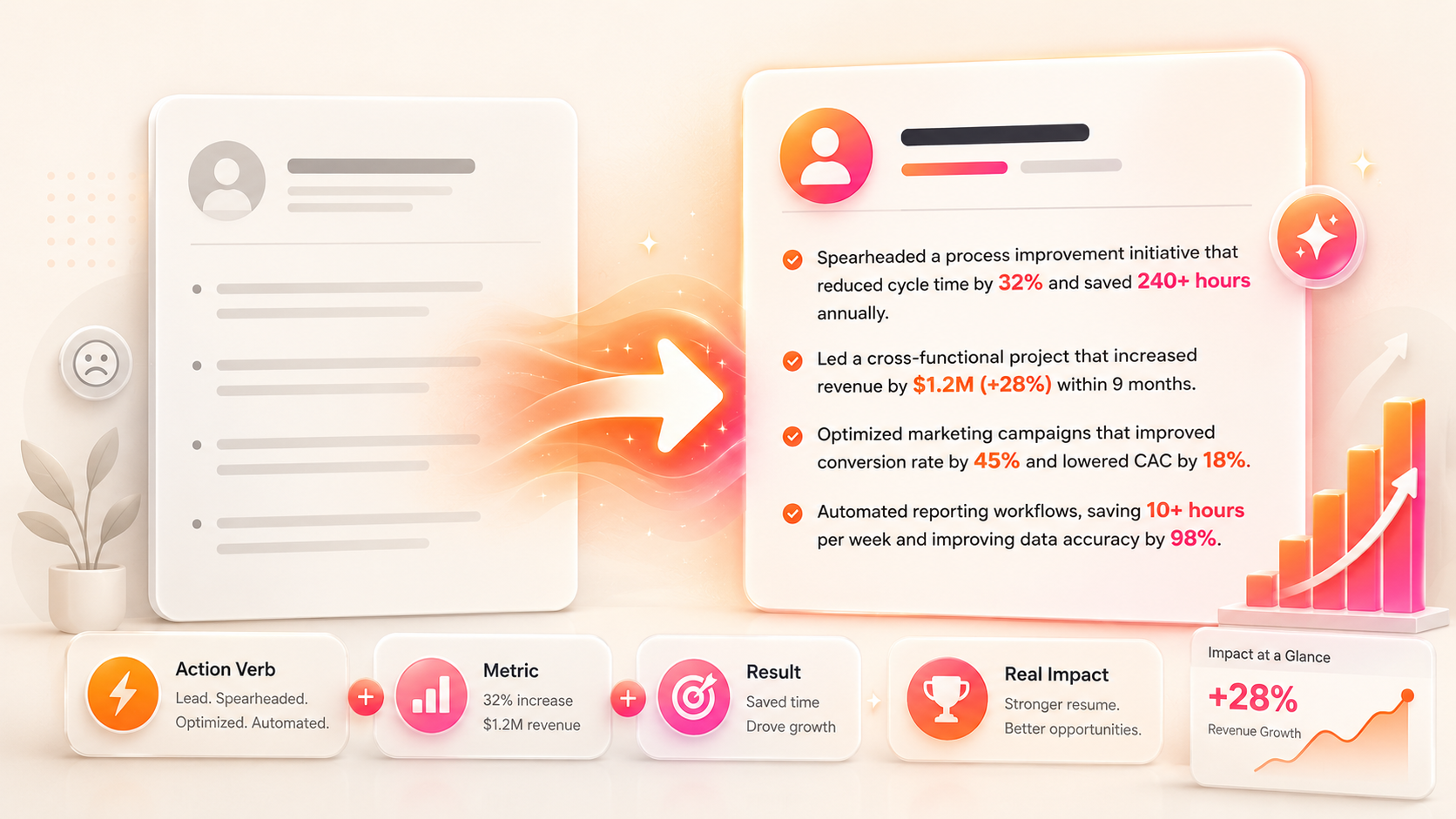
Most resume bullets are too passive.
They say what the person was assigned, not what they accomplished.
Weak bullet:
Responsible for social media campaigns.
Better bullet:
The second bullet is stronger because it shows action, scope, and result.
Responsibilities are not enough
A responsibility tells what you were supposed to do.
An accomplishment tells what you made better.
Responsibility:
Accomplishment:
Your resume should include responsibilities, but the strongest bullets show impact.
“A resume bullet should answer: what did you do, how did you do it, and why did it matter?”
Use the impact formula
Use this formula:
Example:
You do not need every part every time, but the formula helps.
Bullet Builder Card Fields:
Managed weekly social media campaigns that increased engagement by 32% and improved lead quality through audience testing.
Managed reports.
Built weekly KPI reports that helped leadership identify budget shifts and improve campaign performance.
Action + Scope + Method + Result Led cross-functional campaign planning for 12 product launches, using shared timelines and stakeholder check-ins to deliver every launch on schedule.
Generated bullet area.
Start with strong action verbs
Use verbs that show ownership.
Strong verbs:
- Led
- Built
- Managed
- Improved
- Increased
- Reduced
- Created
- Launched
- Streamlined
- Analyzed
- Coordinated
- Developed
- Presented
- Implemented
- Optimized
Avoid weak verbs:
- Helped
- Assisted
- Worked on
- Responsible for
- Participated in
- Involved in
You can use “supported” when accurate, but try to clarify what you actually did.
Action Verb Card Two columns:
Weak → Stronger
Add numbers when possible
Numbers make impact easier to understand.
Use metrics like:
- Revenue
- Cost savings
- Time saved
- Percent improvement
- Number of projects
- Team size
- Budget
- Customers served
- Reports created
- Campaigns launched
- Tickets resolved
- Processes improved
Before:
After:
If you do not know exact numbers, use scope.
Use scope when you do not have metrics
Not every job gives you perfect numbers.
Improved reporting process.
Reduced weekly reporting time by 4 hours by automating dashboard updates and standardizing KPI definitions.
Managed reporting for 8 active campaigns across paid search, email, and organic channels.
Scope still helps.
Scope can include:
- Frequency
- Volume
- Team size
- Tools
- Departments
- Stakeholders
- Timeframe
- Geographic region
- Number of clients
- Budget range
Example:
That is stronger than:
Metrics / Scope Card Two tabs:
Metrics Scope Each tab shows examples.
Match bullets to the job description
A good resume bullet should be true and relevant.
If the job description emphasizes project management, do not bury your project management proof.
If it emphasizes analysis, make sure your analysis bullets are clear.
Example job keywords:
Cross-functional collaboration KPI reporting Coordinated weekly status updates across 5 departments to keep launch timelines aligned.
Coordinated meetings.
Stakeholder communication Budget tracking Tailored bullet:
Keyword Alignment Card Show:
Job description keyword → Real experience → Tailored bullet
Before and after examples
Marketing Before:
After:
Operations Before:
After:
Project management Before:
After:
Managed cross-functional campaign timelines, budget updates, and KPI reporting for multiple stakeholders, improving visibility into performance and priorities.
Responsible for email marketing.
Created segmented email campaigns that increased click-through rate by 18% and improved trial-to-paid conversion.
Handled process improvements.
Streamlined intake process for customer requests, reducing response time by 30% and improving handoff clarity between support and operations.
Managed projects.
Managed timelines, stakeholder communication, and launch checklists for 12 cross- functional projects delivered on schedule.
Common bullet mistakes
Avoid:
- Starting every bullet with the same verb
- Writing bullets that are too long
- Using vague traits
- Listing tasks without outcomes
- Stuffing keywords unnaturally
- Exaggerating results
- Forgetting the job you are applying for
A bullet should usually be one or two lines.
If it takes four lines, tighten it.
Key takeaways
Remember these
- Strong resume bullets show action, scope, and result.
- Do not just list what you were assigned. Show what changed because of your work.
Final takeaway
Better bullets create better interviews.
Make your impact easy to see, easy to believe, and easy to connect to the role.
CTA Answered customer tickets.
Resolved 50+ customer tickets per week while maintaining high satisfaction scores and documenting repeat issues for product feedback.
Turn your real experience into stronger bullets ResumeShine rewrites your resume for the job description while keeping your real experience honest.
See how your resume scores
Upload your resume and ResumeShine highlights what to fix — keywords, impact, and formatting — in minutes.
Frequently asked questions
Usually 3–6 bullets per role.
No. Metrics help, but scope and outcomes also matter.
No. Resume bullets usually omit “I.”